

Geology of the La Ronge Gold Belt
Part of One of the World's Great Mineral Belts
The La Ronge Gold Belt forms part of the Trans-Hudson Orogen (THO), one of the largest Paleoproterozoic mountain belts on Earth. Stretching from the northern United States through Saskatchewan and Manitoba into Nunavut, the Trans-Hudson Orogen records a major mountain-building event that occurred approximately 1.9 to 1.8 billion years ago during the assembly of an ancient supercontinent.
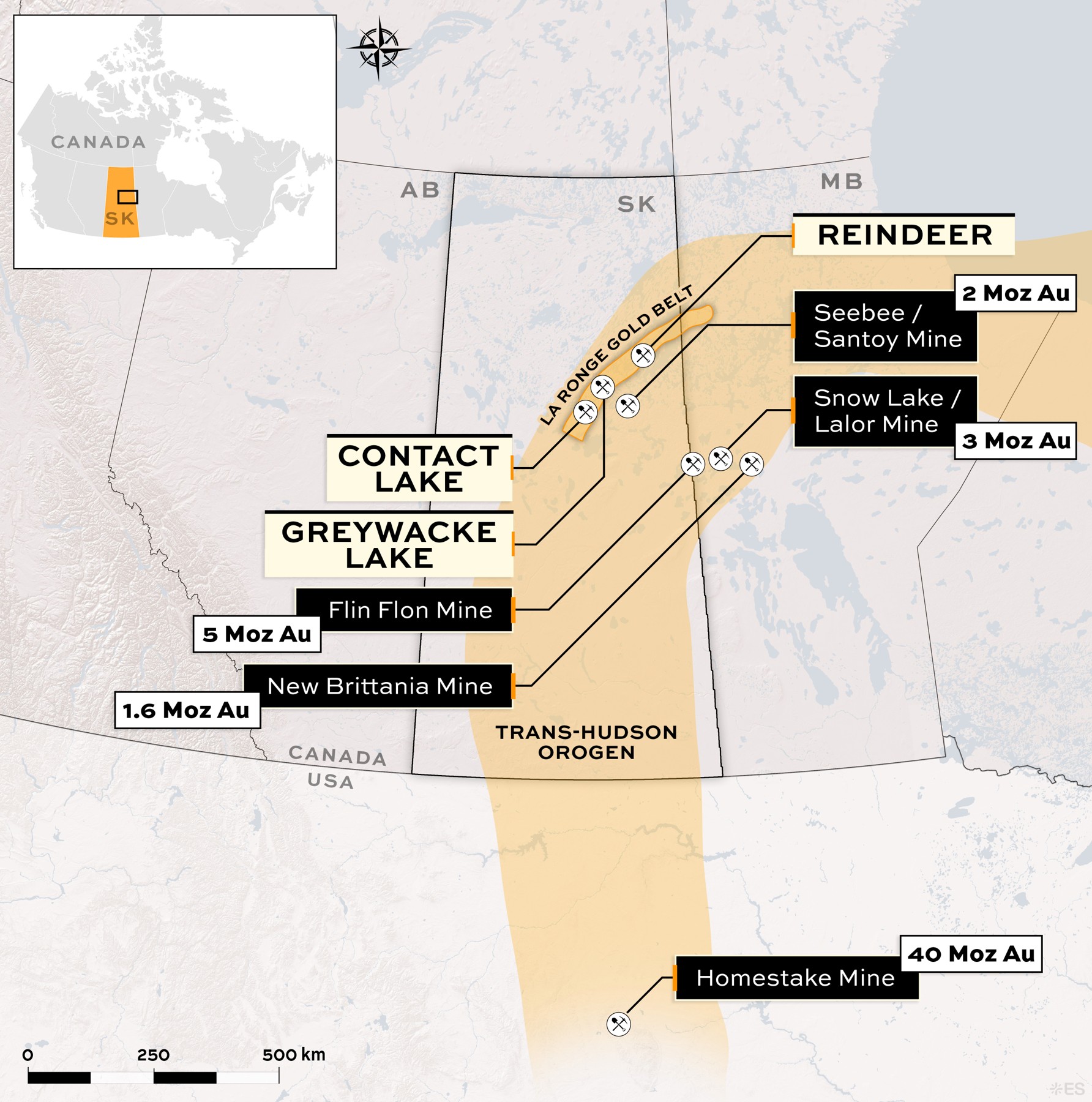
This continental collision created a network of volcanic arcs, sedimentary basins, intrusive bodies, and regional fault systems that now host numerous significant gold and base metal deposits across North America. Today, the Canadian Shield exposes these rocks at surface throughout northern Saskatchewan, providing direct access to one of the world's important Proterozoic mineral provinces.
A Geological Environment for Large Gold Systems
Mountain-building events do more than reshape continents. They generate the heat, pressure, magmatism, and structural deformation required to circulate mineral-rich hydrothermal fluids through the Earth's crust.
Where these fluids migrate along major faults and shear zones, gold can be deposited within favourable host rocks. Repeated deformation over millions of years can concentrate gold into extensive mineral systems that later become exploration targets and, in some cases, producing mines.
The Trans-Hudson Orogen contains many of these regional structures, making it an important geological setting for orogenic gold deposits.
World-Class Gold Deposits
The geological significance of the Trans-Hudson Orogen is demonstrated by the number of important gold camps located within it.
Among the best known is the Homestake Gold Mine in South Dakota, which produced more than 40 million ounces of gold over its 126-year operating history and remains the largest known Proterozoic orogenic gold deposit in the world. The Homestake deposit formed during Paleoproterozoic continental collision associated with the Trans-Hudson Orogen, demonstrating the capacity of this geological environment to generate exceptionally large gold systems.
Within Saskatchewan, the Trans-Hudson Orogen also hosts significant gold operations, including the Seabee Gold Operation, where ongoing geological research continues to improve the understanding of large, interconnected orogenic gold systems.
The La Ronge Gold Belt
The La Ronge Gold Belt occupies part of the Reindeer Zone of the Trans-Hudson Orogen, a structurally complex region formed through the collision and accretion of multiple volcanic arcs and continental fragments. This history produced a diverse assemblage of volcanic rocks, sedimentary sequences, granitoid intrusions, and major structural corridors that provide favourable conditions for gold mineralization.
The belt hosts:
- Past-producing gold mines
- Established mineral resources
- Numerous documented gold occurrences
- Extensive regional shear zones and fault systems
- Large areas that remain lightly explored using modern exploration techniques
A Convergence of Geological Domains
Trident's land position occupies one of the most prospective areas within the belt, where several geological domains converge.
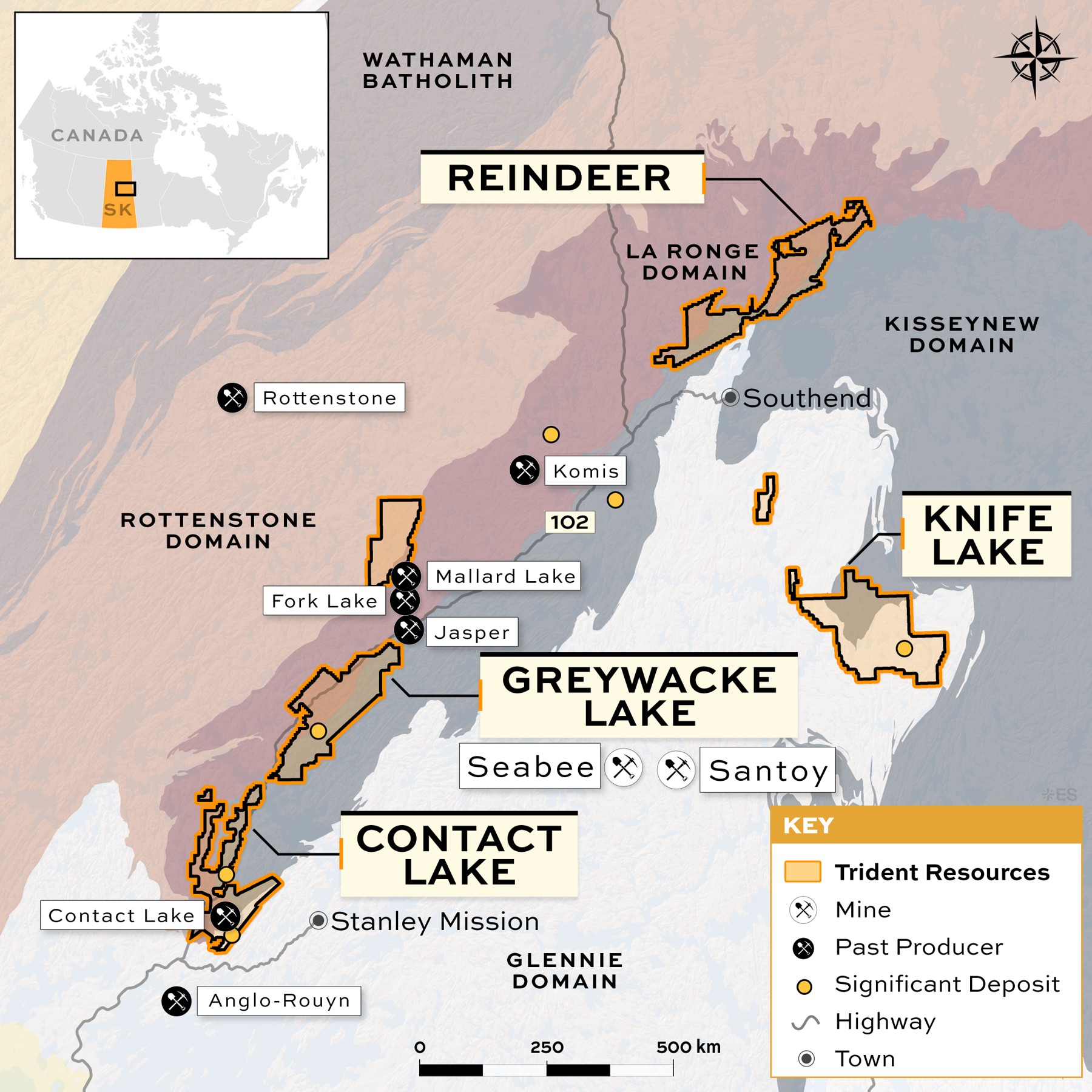
The Contact Lake area lies near the intersection of the La Ronge, Kisseynew, and Glennie Domains within the Reindeer Zone of the Trans-Hudson Orogen. These domain boundaries represent deep crustal structures that have influenced the movement of mineralizing fluids and the distribution of gold mineralization throughout the region.
This regional geological setting supports Trident's district-scale exploration strategy and provides a framework for evaluating multiple gold systems across its land position.
Trident's Regional Land Position
Trident has assembled approximately 98,700 hectares across its core project portfolio within the La Ronge Gold Belt, supported by a growing regional land position of approximately 160,300 hectares.
The portfolio includes past-producing mines, established mineral resources, advanced exploration projects, and regional exploration properties distributed across the belt. By applying consistent geological models across this regional land position, the Company continues to refine its understanding of the district while advancing multiple projects through systematic exploration.
See Projects Overview